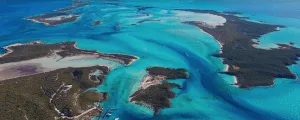
Planning a Bahamas yacht charter raises the same questions for almost everyone: what it really costs, how the APA works, when to go, and how booking actually runs. For the money side, start with our full cost breakdown: How Much Does a Bahamas Yacht Charter Cost? Then search or browse below for the details.
William Mc NallyYacht charter broker, DMA Yachting
Yes, with the right yacht, and choosing that yacht is exactly the kind of work we do. Catamarans put most of the living space on one level with wide, stable decks. Larger motor yachts add short stair runs but calmer motion, and some superyachts have elevators between decks. What we avoid is narrow-companionway boats where every move is a climb.
The crew makes the bigger difference: boarding help at the passerelle, tender transfers matched to the guest’s pace, and anchorages chosen for calm water and easy beach access. The Bahamas’ flat, protected water is genuinely one of the friendliest cruising grounds for this.

Be specific with us about mobility needs when you inquire, wheelchair, walker, or just slower on stairs, and we shortlist only yachts and crews that fit. It is a normal request, and the difference between the right and wrong boat is the whole vacation.
Read more
Martina AsmusYacht charter broker, DMA Yachting
Pack light, and pack it in soft-sided bags: yacht cabins have clever but limited storage, and a hard suitcase has nowhere to live once emptied. Daily life aboard is swimwear, cover-ups, shorts, and sunglasses; add one smarter outfit for dinners ashore and a light layer for breezy evenings, especially December through February when winter fronts pass.
Leave the hard-soled shoes at home; decks are barefoot or boat-shoe territory, and the crew will say so on boarding. Bring reef-safe sunscreen (you will swim more than you think), a hat, any medications, and seasickness tablets if anyone is unsure, even though Bahamas waters are calm.
You need less than you think: towels, snorkeling gear, water toys, and usually laundry are on the boat, and the crew handles the rest. If you are missing something, Nassau has it before departure; the Exumas will not.
Read more
Daniel AsmusYacht charter broker, DMA Yachting
Most crewed yachts in our Bahamas fleet now carry Starlink, which changed the answer to this question completely. It matters more here than in most charter destinations: the Bahamas is genuinely remote, and once you leave Nassau behind, whole stretches of the Exumas have no cell signal at all. On a Starlink-equipped yacht you can still take a video call from that empty anchorage, and working a morning from the flybridge is realistic, not hopeful marketing.
The honest caveat: setups differ by yacht in speed, coverage, and how many devices share the connection. If working aboard is a requirement rather than a nice-to-have, tell us before we shortlist, and we confirm the specific yacht’s system with the captain rather than assuming.
Two practical notes: mobile coverage between Nassau and the far Exumas is patchy, so the yacht’s wifi is your reliable link, not your phone plan. And if you want the opposite, a week where nobody can reach you, that is still fully available.
Read more
John BoullinYacht charter broker, DMA Yachting
Yes, and celebrations are some of the best charters we arrange. Tell us the occasion when you inquire and the crew builds around it: decorated cabins and cakes for birthdays, champagne at anchor for honeymoons, a proposal set up on a private sandbar with the tender standing by. The crew genuinely enjoys these weeks; a proposal on board is an event for everyone.
For weddings and bigger events, the practical questions are guest count and format. A ceremony aboard works for intimate groups within the yacht’s licensed day-guest limit; larger parties usually pair a shore venue with a yacht week, or split guests across two boats. We have organized wedding-day charters with photographers, florists, and transport coordinated around the boat.
If the celebration is a single day rather than a week, see can I charter a yacht for one day? Either way, say the occasion up front; it changes which yachts and crews we shortlist.
Read more
Marcelle HailwaxYacht charter broker & former yacht chef, DMA Yachting
Whatever your group loves to eat, cooked by a private chef who provisioned the boat specifically for you. Before the charter you fill in a preference sheet: favorites, dislikes, allergies, how adventurous the table should be, and what the bar should hold. The chef builds the whole week’s menus around it. This answer comes from inside the galley: Marcelle cooked aboard charter yachts before joining our broker desk.
Provisioning is the part guests never see and the chef sweats the most. Everything is bought in Nassau before departure, because once you are in the Exumas there are no supermarkets, so a good chef plans seven days of menus, backups included, before the first anchor drops. It is also why the preference sheet matters so much: a forgotten allergy cannot be fixed at a corner store two islands from anywhere.
Expect the Bahamas on the plate: conch salad made fresh on deck, Bahamian lobster in season (August to March), and whatever your group catches if you fish, cooked that evening. Dietary needs are routine, not a complication; vegan, gluten-free, kosher-style, and kids’ menus are everyday work for charter chefs.
On standard charters the food and drinks come out of the APA, and the bar follows the same preference sheet, from house wine to the sunset rum.
Read more
Louis LamprellYacht charter broker, DMA Yachting
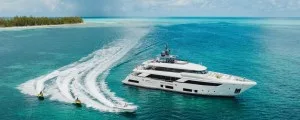
No. The Bahamas has no license requirement for charter guests using the yacht’s own jet skis, unlike Croatia or Spain, where a recognized license is legally required. What governs jet ski use here is the yacht’s insurance: expect a safety briefing from the crew, a minimum driving age (16 on most boats, sometimes 18), and the crew keeping an eye on where you ride. Younger kids can usually ride behind an adult.
Not every yacht carries jet skis, because they are expensive to insure, so tell us early if they matter to your group and we will shortlist boats that have them. Some yachts also carry seabobs and other powered toys; those are sometimes billed separately, so we confirm what is included in the quote.
The Bahamas is one of the best places anywhere to actually use them: flat, protected water behind the sandbanks, empty stretches of sea, and sandbars to beach up on. It is a very different experience from dodging swim buoys off a crowded beach.
Read more
Marcelle HailwaxYacht charter broker, DMA Yachting
14% of the base charter fee. Since July 1, 2025 it is a single consolidated charter fee collected through the Bahamas Port Department; before that it was split into 10% VAT plus a 4% Port Department fee, so the total is unchanged, only the collection is simpler.
It applies to the charter fee only. Your APA is not taxed, and neither is the crew gratuity. On a $60,000 charter, the tax is $8,400, and it is due with the final payment.
It is the highest charter tax in the region, which makes quote comparison tricky: some brokers leave it out of early numbers to look cheaper. Every quote we send includes it from the first line, so the number you approve is the number you pay.
Read more
Daniel AsmusYacht charter broker, DMA Yachting
The Bahamas has a clear weather high season and low season. High season runs December through May: dry, settled weather, with March through May the sweet spot for warm water and steady conditions. December through February is popular but can bring cooler, windier days when winter fronts pass through. Low season is June through November, which is hurricane season: hotter, stormier, and much quieter on the water.
Charter rates are a different story, and this surprises many clients. Bahamas pricing does not swing between seasons the way Mediterranean pricing does. Most yachts keep fairly level rates year round, with two true price peaks: Thanksgiving and the Christmas to New Year weeks, when the best boats book out months ahead at premium rates and longer minimums.
The practical consequence: booking in the low season saves less than you might hope, so we do not recommend chartering in the peak hurricane months of August to October just to chase a discount. If you do book summer or fall, we make sure the contract carries a hurricane addendum, so a named storm does not put your money at risk.
Every yacht sets its own calendar and some change rates week by week, so inquire for exact pricing on your dates. For the weather month by month, see Best Time for a Bahamas Yacht Charter.
Read more
Lian BlacquiereYacht charter broker, DMA Yachting
15 to 20% of the base charter fee is customary, with motor yacht crews at the higher end of that range. It is always at your discretion and should reflect the service you actually received, but plan for it in the budget from the start; on a $60,000 week that is $9,000 to $12,000.
The practical side: the gratuity is handed to the captain at the end of the charter, usually in cash or by pre-arranged transfer, and the captain splits it evenly among the whole crew, including the ones you saw less of, like the engineer who kept the air conditioning running.
If service ever falls short mid-trip, tell the captain or your broker then, not at tip time; almost everything is fixable while you are still aboard. Full budget math in what a Bahamas charter really costs.
Read more
Chris de KockYacht charter broker, DMA Yachting
Book your flights after the charter agreement is signed, not before. It is far easier to move a flight, even for 12 people, than to move a yacht: the boat you want has to be free, in the port you need, on your exact dates, and that is the hard part of the puzzle.
Staying flexible until the contract is signed can also save real money. A few days of flexibility sometimes unlocks a better yacht or avoids a delivery fee for bringing the boat to you.
We see the reverse case too. Clients book flights first, then rebook them for a few hundred dollars when the right yacht is not available on those exact dates. Annoying, but much cheaper than compromising on the boat you will live on for a week.
For the Bahamas, most of our clients fly into Nassau (LPIA). Land by early afternoon and you can be aboard and anchored off Rose Island the same evening. If you are considering starting from Florida instead, read Miami to Bahamas Yacht Charter: Is It Worth It?
Read more
William Mc NallyYacht charter broker, DMA Yachting
Yes. DMA Yachting carries professional indemnity insurance up to EUR 500,000 with ITIC, the International Transport Intermediaries Club, the specialist insurer for yacht brokers and other transport intermediaries.
This matters more than it sounds. Yacht chartering runs on large wire transfers, so before you send a deposit to any broker, check that they are insured, reachable, and working under a proper charter contract. We are happy to be checked.
Note that this covers our work as your broker. It is separate from trip cancellation insurance for you as the guest. If you want your charter fee protected against illness, weather, or plans changing, ask your broker about cancellation and curtailment cover when you book.
Read more
Daniel AsmusYacht charter broker, DMA Yachting
Unlikely, by charter standards. The Bahamas is one of the calmest cruising grounds we book. The Exumas sit on shallow banks where sandbars stop the ocean swell, so yachts spend most of the week in flat, protected water, and the daily legs are short, often 10 to 40 nautical miles.
If anyone in your group is nervous about motion, tell your broker and we build the trip around it. A catamaran is the steadiest platform: two hulls, no heeling, and very little roll at anchor, which is where you spend most of your time. On motor yachts, many of the boats we shortlist carry stabilizers that settle the ride under way and at anchor.
The honest caveat: winter cold fronts can bring a couple of windy days, and any open-water crossing has some movement. A good captain plans around both, tucking into the lee side of the islands and choosing calm anchorages, which the Bahamas has in huge supply.
Read more
Martina AsmusYacht charter broker, DMA Yachting
Sometimes. Outside the holiday peaks, and especially on larger yachts, managers will consider a serious offer. The way to do it is to make one through your broker: we know which managers negotiate, which have a strict no-discount policy, and what number is worth putting on the table.
Two things to know before you offer. First, an offer is treated as binding, so be ready to sign quickly if it is accepted. Second, shopping the same yacht through several brokers does not create leverage; managers see every inquiry and it works against you.
Watch out for one trick when comparing quotes: a competitor may look cheaper because they quoted a lower APA, not a lower price. The APA is your own onboard budget, and if it runs out you pay the difference on board, so a shaved APA is not a saving. Compare charter fee against charter fee.
Read more
Louis LamprellYacht charter broker, DMA Yachting
On most crewed motor yachts, no. The weekly rate you see covers the yacht and its crew. Food, drinks, fuel, and dockage are paid from the APA, an onboard budget of 25 to 40% of the charter fee that you pay before the trip. Whatever the crew does not spend is refunded to you afterwards.
Many Bahamas catamarans work differently: they run all-inclusive, with provisioning, fuel, and standard bar built into one price. That is why a catamaran and a motor yacht at the same headline rate are not the same total budget, and why we always quote the all-in number, not just the base rate.
The 14% Bahamas charter tax and crew gratuity are separate in both cases. For worked examples, see How Much Does a Bahamas Yacht Charter Cost?
Read more
John BoullinYacht charter broker, DMA Yachting
Two yachts, in most cases. For big groups, splitting across two boats usually comes out 20 to 50% cheaper than one yacht large enough to sleep everyone. Yacht cost climbs steeply with size, and most charter yachts are limited to 12 guests anyway, so the single-boat option quickly means a much larger, much more expensive vessel.
Two boats cruising together is called a tandem charter, and it works better than most groups expect: the yachts anchor side by side, guests move between them, and the captains coordinate the route so nobody misses the fun. We keep a shortlist of yacht pairings that have run tandems together before, which makes the whole thing smoother. More here: what is a tandem charter?
Day charters are a different calculation, and there are occasional exceptions for yachts licensed above 12 guests. Tell us your headcount and dates and we will price both versions for you.
Read more
William Mc NallyYacht charter broker, DMA Yachting
Six to twelve months ahead is the sweet spot. Yacht charter is a seller’s market: each yacht is one-of-one, and the best Bahamas boats are booked out six months or more, with holiday weeks going even earlier. A year out you choose from nearly the whole fleet; three months out you are choosing from what is left.
This is the opposite of hotel logic, and it surprises clients who wait for last-minute deals. Those deals exist occasionally, but the odds that the right boat, port, and budget line up on your exact dates are low.
Not sure yet? Inquire anyway. If your trip is even 50% likely, it is the right time to start: we can tell you what is available in your window and hold nothing against you if plans change. For the calendar pressure points, see when are the high and low seasons?
Read more
Louis LamprellYacht charter broker, DMA Yachting
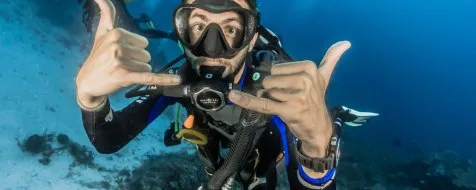
Yes, and the Bahamas is one of the easier places to dive from a charter yacht. A good number of our Bahamas yachts carry full scuba setups onboard: tanks, gear, a compressor, and crew qualified to lead dives straight off the swim platform. We keep a live list of them here: charter yachts with scuba diving onboard, currently over a dozen boats from sailing catamarans to superyachts.
If the yacht you love does not carry gear, rendezvous diving covers it: a licensed local dive operator meets the yacht at the day’s anchorage with equipment and a divemaster, you dive, and the itinerary rolls on. It works anywhere on the route and suits mixed groups where only some guests dive.
No license? You can still dive. Uncertified guests can do a beginner “discover scuba” dive with a licensed instructor, either through the rendezvous operator or on yachts whose crew includes a dive instructor: a briefing, shallow water, an instructor at your side, no card required. If you want to dive properly all week, we recommend completing an Open Water course before the trip; the classroom part can be done online at home. And snorkeling needs no license at all, which in the Exumas covers a surprising share of the highlights.
Two practical notes from our bookings. Certified divers should bring their certification cards; the crew will ask before anyone gets a tank. And diving is usually billed as an extra rather than folded into the charter fee, even on yachts that offer it, so tell us up front if diving matters and we will price it into the quote instead of leaving it as a surprise.
The diving itself earns the effort: shallow reefs, wrecks, walls dropping off the banks, and Thunderball Grotto for the snorkelers in the group.
Read more
Lian BlacquiereYacht charter broker, DMA Yachting
Yes. On a crewed charter the captain, chef, and stewardess live aboard for the whole trip. They have their own crew quarters, separate from the guest cabins, which is why a yacht listed with 4 guest cabins genuinely sleeps 8 guests: the crew is not using any of them.
They are also on duty in the way that matters: meals, drinks, watersports setup, moving the boat while you swim, and local knowledge on tap all day.
On captain-only charters the captain still sleeps aboard, sometimes in a dedicated cabin, sometimes in the saloon, depending on the boat’s layout. If cabin privacy matters to your group, ask us how a specific yacht arranges it and we will confirm before you book.
Read more
William Mc NallyYacht charter broker, DMA Yachting
We recommend it, and for Bahamas summer and fall bookings we recommend it strongly. Cancellation and curtailment insurance protects your charter fee if illness, travel disruption, or other events force you to cancel or cut the trip short.
Charter contracts have firm cancellation terms because the owner holds the yacht exclusively for you; past certain dates, payments are not refundable. Insurance is the clean answer to that risk, and it costs a small fraction of the charter fee.
Your broker can point you to suitable trip insurance when you book. It pairs with the hurricane terms in the contract itself, which we cover in what happens if weather affects our charter? If you are looking at summer or fall dates, our guide to chartering the Bahamas during hurricane season explains how the insurance and the contract terms work together.
Read more
John BoullinYacht charter broker, DMA Yachting
The balance of your charter fee, the APA, and the 14% Bahamas charter tax are due together about six weeks before your charter starts. Some contracts state it as 60 days; your charter agreement will show the exact date.
The APA, your onboard budget for food, drinks, fuel, and dockage, then travels with the boat. The captain spends from it during the week and keeps the accounts, and every charter cost is reconciled before you disembark. Whatever is unspent comes back to you after the charter.
We also go through the captain’s APA accounts ourselves. We know what fuel, provisioning, and dockage should cost in the Bahamas, so you are not left interpreting a spreadsheet alone on the last morning.
Read more
Chris de KockYacht charter broker, DMA Yachting
No. Our service is free to you. Like a travel agent, we are paid a commission from the yacht’s side, and the charter fee is the same whether you book through us or approach the boat directly. There is no markup for using a broker.
What you get for that same price: market knowledge of which boats and crews actually deliver, negotiation on your behalf, itinerary planning, preference-sheet handling, and someone checking your APA accounts so every onboard charge is correct.
The one thing we ask in return is simple: pick one broker and work with them. Sending the same inquiry to five brokers just means the same yacht managers see your name five times, and nobody can negotiate well for you after that.
Read more
John BoullinYacht charter broker, DMA Yachting
It depends on your contract, so we make sure the right terms are in it before you sign. For June through November bookings we add a hurricane addendum, which sets out what happens if a named storm affects your dates: typically rescheduling or credit rather than losing your fee. Do not book a summer charter without one.
Day-to-day weather is a different matter, and it is the captain’s call. If wind makes an anchorage or crossing uncomfortable, the captain will propose alternatives; the Bahamas has so many protected options that a weather day usually means a different beautiful bay, not a lost day. On safety questions the captain’s decision is final, and that is written into every charter contract for good reason.
For full protection of the fee itself, pair the contract terms with cancellation insurance. And for the full picture, including how often storms actually affect trips and how the addendum plays out in practice, see our Bahamas hurricane season charter guide.
Read more
Louis LamprellYacht charter broker, DMA Yachting
Yes, and by yacht is the best way to do it. The famous swimming pigs live on Big Major Cay, better known as Pig Beach, right next to Staniel Cay in the Exumas. On the classic route it is a natural mid-week stop, and you visit by tender straight from your anchorage.
The broker tip: go in the early morning. The day-tour boats from Nassau arrive late morning, and before they do, your group often has the beach and the pigs nearly to yourselves. Bring vegetables from the galley, keep fingers clear, and the crew handles the rest.
The same anchorage gives you Thunderball Grotto around the corner and the nurse sharks at Compass Cay one stop north, which is why we plan a full day or two around Staniel Cay in the Exumas itinerary.
Read more
Daniel AsmusYacht charter broker, DMA Yachting
The standard structure is simple: 50% of the charter fee is due when you sign the charter agreement, and the remaining 50%, together with the APA and the 14% Bahamas charter tax, is due about six weeks before you step aboard.
If you book far in advance, roughly a year or more, we can often arrange a split of 25% on signing, 25% at the halfway point, and the balance six weeks out. That depends on the owner agreeing, so ask your broker before counting on it.
Payment is by bank transfer. That is the industry standard for good reason, and it is why we always confirm account details with you directly. If you are wondering about credit cards, we explain the tradeoffs here: can I pay for my charter with a credit card?
Every deadline and amount is laid out in the charter agreement before you sign, so there are no surprises on timing.
Read more
Daniel AsmusYacht charter broker, DMA Yachting
Short answer: sometimes for the first installment, but we almost never recommend it. The card company’s exchange rate plus the processing surcharge, direct or hidden, usually costs you more than any points or miles are worth on amounts this size.
There is also a reason the whole industry runs on bank transfers: chargebacks. Card payments can be reversed months later, so owners and managers price that risk in or refuse cards outright. A transfer clears cleanly, which is also why it gets you the better terms.
Our advice: send a bank transfer, check the exchange rate yourself if you are paying across currencies, and put the card points budget toward the flights instead.
Read more
William Mc NallyYacht charter broker, DMA Yachting
Usually not, and it is worth understanding why. Every charter yacht has two licensed limits: the number of guests it may carry by day and the number it may sleep overnight. Those caps come from the yacht’s registration and insurance, not from the crew’s goodwill, so managers hold the line even for small children. We have seen occasional flexibility for infants under 12 months, decided case by case.
The good news is that this problem is almost always solvable with the right boat. The usual fixes: a similar yacht with Pullman berths (fold-away bunks that add sleeping spots), stepping up one size, or splitting the group across two yachts that cruise together.
If your group is bigger than the boat you fell in love with, read should we take one yacht or two? Tell us the real headcount, including the little ones, and we shortlist yachts that fit it legally.
Read more
Louis LamprellYacht charter broker, DMA Yachting
A tandem charter is one vacation spread across two yachts that cruise together. One captain leads, the boats coordinate their route and anchorages, and the group mixes freely: kids can go off for watersports on one boat while the adults take a quiet bay on the other, and everyone meets up for dinner ashore. Three or more boats doing the same is called a flotilla charter; the same idea with more logistics, and we have organized those too.
It is our standard recommendation for groups beyond 12 guests, because most charter yachts cannot legally sleep more than that, and two mid-size yachts usually cost well under one huge one.
The pairing matters: not every two yachts make a good team. We keep a list of combinations that have run tandems together before and we clear the plan with both yacht managers, so the coordination is agreed before you sign rather than improvised on the water.
Read more
Chris de KockYacht charter broker, DMA Yachting
Nassau, for almost everyone: Lynden Pindling International (NAS) has direct flights from the US East Coast and Europe and is around 30 minutes from the marinas. Land by early afternoon and you can be aboard and at anchor off Rose Island before sunset.
If your charter starts deeper in the islands, there are alternatives: Exuma International in Georgetown (GGT) or the Staniel Cay airstrip for Exumas starts, and Marsh Harbour (MHH) for the Abacos, mostly reached via Nassau or Florida.
Book the flights only after the charter agreement is signed; here is why the order matters. And send us your flight times, because the crew plans boarding, provisioning, and the first anchorage around your arrival.
Read more
Marcelle HailwaxYacht charter broker, DMA Yachting
Because those two amounts are not the same for every yacht, so baking them into the listed price would make every rate wrong for someone. The Bahamas charter tax is the predictable part: a flat 14% of the charter fee, collected through the Bahamas Port Department since July 1, 2025, when it replaced the old 10% VAT plus 4% port fee.
The APA is the variable part. It is your onboard budget for food, drinks, fuel, and dockage, usually 25 to 40% of the charter fee. Where a yacht lands in that range depends mostly on fuel: a modern, efficient yacht on a relaxed Exumas loop needs far less than an older boat covering long legs. Unused APA is refunded after the charter.
What we promise instead: the first quote you get from us shows the full all-in number, charter fee, tax, APA, and expected gratuity, so you compare real costs between yachts, not headline rates.
Read more
Susannah DeehanYacht charter broker, DMA Yachting
Yes. The Bahamas is an international destination, so every guest, children included, needs a valid passport to fly in, and it is the document the yacht uses to clear you with Bahamian customs and immigration. We recommend at least six months of validity remaining, which keeps you clear of airline rules.
US citizens sometimes ask about cruise-style exceptions; those apply to closed-loop cruises, not to flying into Nassau for a charter, so bring the passport.
The process itself is painless. Send passport details with your preference sheet and the captain handles the paperwork; you mostly notice it as a form to sign on boarding day. Visas are not required for US, Canadian, UK, and EU passport holders on stays this length.
Read more
Martina AsmusYacht charter broker, DMA Yachting
Yes. A crewed yacht charter is one of the most protected ways to travel: you sleep on a private yacht, your itinerary runs through quiet cays and anchorages, and a professional crew with local knowledge is with you the whole week. In the Exumas you will often see more iguanas than people.
The safety headlines you may have read concern specific areas of Nassau and travel situations far removed from a charter. Aboard, the practical picture is the crew choosing anchorages they know, watching the weather, and handling every logistics step. Standard city precautions apply if you explore Nassau on your own, the same as any port city.
The sea itself is the mildest part: shallow, protected banks and short hops between islands. If anyone in your group has concerns, tell your broker and we will shape the route and stops around them.
Read more
Daniel AsmusYacht charter broker, DMA Yachting
Yes, and the Bahamas is one of the best places in the world to do it from a charter yacht: mahi mahi, wahoo, tuna, and marlin offshore, and world-class bonefishing on the flats. A deep-sea morning fits naturally into an Exumas week, with the yacht repositioning while you fish.
Many of our motor yachts carry fishing gear, and some are seriously geared for it: outriggers, fighting chairs, and crew who know the drop-offs. If fishing is a priority rather than a maybe, say so up front and we shortlist those boats specifically.
Recreational fishing by charter guests is handled under the yacht’s Bahamas cruising paperwork, and your captain confirms the current rules and limits, including what the galley can do with your catch, which is the best part. Dedicated fishing-focused yachts are here: Bahamas fishing charters.
Read more
Lian BlacquiereYacht charter broker, DMA Yachting
Not quite. Every yacht has a homeport, and in the Bahamas that is usually Nassau, so most charters start and end there. Starting somewhere else, deeper in the Exumas for example, is often possible, but it means repositioning the yacht and a delivery fee that reflects the fuel and crew time.
Sometimes that fee is worth it: a one-way or remote start can buy you a full extra day in the best part of the route. Sometimes it is not, and the smarter plan is boarding in Nassau and letting the itinerary flow naturally. We run the numbers both ways for you.
There are also physical limits: draft decides which marinas and cuts a yacht can enter. The more specific you are about where you want to start and finish, the faster we can tell you which boats genuinely fit the plan.
Read more
Nadja AsmusYacht charter broker, DMA Yachting
First, we confirm reality: whether the yacht you asked about is actually free on your dates, and at what price, since rates move through the year. At the same time we pull together comparable boats, including ones with better deals or better crew fit, so you choose from a real shortlist rather than one listing.
Once you pick, the steps are: charter agreement, then payments per the contract terms, then the preference sheet. That sheet is where the trip gets personal: dietary needs, allergies, drinks, celebration plans, watersports priorities. The crew provisions the boat around it, which is why we take it seriously.
From inquiry to signed contract can take a day or a month; it moves at your pace, and asking questions costs nothing.
Read more
Susannah DeehanYacht charter broker, DMA Yachting
Yes, we arrange bareboat charters too. Tell us the yacht type, dates, group size, and budget, and we will line up the options, along with the qualifications the charter company will ask you to show.
Two honest notes for the Bahamas specifically. The fleet here is heavily weighted toward crewed motor yachts, so bareboat selection is thinner than in, say, the BVI. And the banks are genuinely shallow: navigating the cuts and sandbars is reading-the-water sailing, best suited to skippers with real experience.
If you are weighing the two, start with the difference between crewed and captain-only. Many groups who ask about bareboat end up happiest with a captain aboard and the rest of the trip to themselves.
Read more
Chris de KockYacht charter broker, DMA Yachting
On a fully crewed charter you are a guest; on a captain-only charter you are the crew. A crewed yacht comes with at least a captain plus a chef or stewardess: meals cooked, cabins made up, drinks appearing, watersports launched for you. A captain-only charter gives you a professional at the helm, but the provisioning, cooking, and cleaning stay with your group.
The price gap is real, and so is the comfort gap. In our experience the crewed charter is the version people imagine when they picture a yacht vacation, and it is a huge step up for the same destination. If it fits your budget, choose crewed.
If the numbers do not work, talk to us before settling. Sometimes the better answer is a slightly smaller crewed yacht, a catamaran instead of a motor yacht, or different dates, rather than giving up the crew. In the Bahamas, nearly all the motor yachts we book are fully crewed.
Read more
John BoullinYacht charter broker, DMA Yachting
Crewed motor yachts in the Bahamas start at about $40,000 per week in base rate, and most of our clients book between $60,000 and $200,000 before expenses. Crewed catamarans open lower, and many of them run all-inclusive, which changes the math below.
On a standard motor yacht, the base rate is roughly 60% of the real total. Add the APA of 25 to 40% for food, drinks, fuel, and dockage, the 14% Bahamas charter tax, and a 15 to 20% crew gratuity, and the all-in week lands at about 1.6 to 1.75 times the base rate. A $60,000 yacht is realistically a $100,000 week.
We quote the all-in number from the first email, because comparing base rates across yachts with different APAs and inclusions is how people overspend. Worked examples: How Much Does a Bahamas Yacht Charter Cost?
Read more
Marcelle HailwaxYacht charter broker, DMA Yachting
Yes. Day charters run mostly out of Nassau: a morning start, beaches, sandbars, and snorkeling stops around Rose Island or the nearby cays, and cocktails on the way home. Larger crewed yachts generally take multi-day bookings, so the day fleet is its own set of boats, and we know which ones deliver.
We have also organized one-day events aboard: weddings, birthdays, corporate days, with transport, catering, and photographers coordinated around the boat.
If you are tempted to stretch it, the interesting threshold is 2 to 3 days, where day-boat pricing crosses into proper crewed charter territory and the Exumas come into range. Tell us the occasion and headcount and we will show you both versions.
Read more