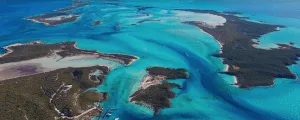
Seven decisions shape a Bahamas charter more than anything else. Here they are, with our answer to each.
The ones people get wrong are the boat type, the cost and the group size. The first because the shallow-water rule of thumb is mostly wrong at charter sizes, the second because the advertised rate is about two thirds of the real number, and the third because the fleet stops at 12 guests.
1. When to go: March to May
March through May is the window: warm water, settled weather, sandbars at their best. May and November are the value shoulder months. Christmas, New Year and Easter carry premium terms and book furthest ahead.
Check the rate on the boat, not the calendar. Many Bahamas yachts publish one rate all year and add a holiday rate on top. Others carry a separate summer high rate.
Summer is not off the table. We keep booking through hurricane season, June 1 to November 30, because the contract does the work. A storm addendum turns a named storm on your dates into a new date or a credit, not a lost fee.
The risk is smaller than the label suggests. September is the most active month, and even then a hurricane passing within 100 miles of the northern Bahamas runs at roughly 8 percent.
More: our month-by-month guide and our hurricane season guide.
2. Catamaran or motor yacht
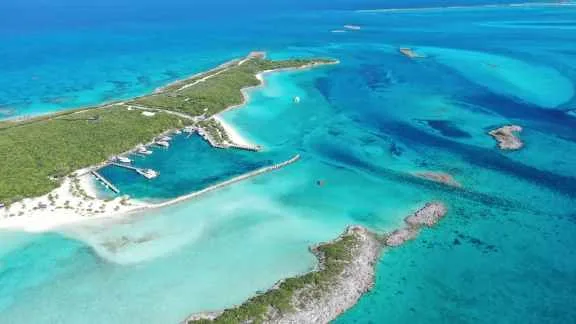
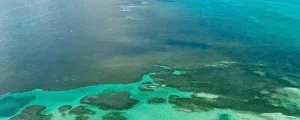
The Bahamas is shallow, so the received wisdom is to book a catamaran. At charter sizes that advantage mostly disappears.
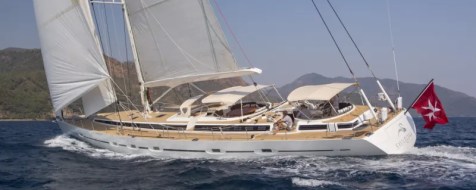
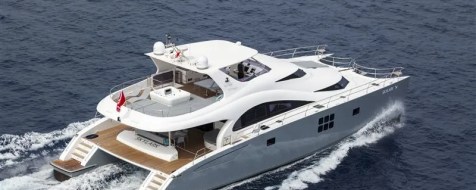
Our top Bahamas catamarans draw 4.4 to 7.0 feet. Our top Bahamas motor yachts draw 6.0 to 8.1 feet. Above roughly 70 feet the two ranges overlap almost completely. ENDLESS HORIZON, an 80 foot catamaran, draws 7.0 feet, the same as MISS CHRISTINE at 157 feet.
The shallow-water advantage belongs to power catamarans and to sailing cats under about 65 feet. Fountaine Pajot builds a 67 in both, and the power version draws 3.8 feet against the sailing version at 5.6.
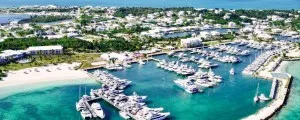
Eight feet is the number that shapes a week, because it is where the marinas stop. Highbourne Cay takes 8 feet, Compass Cay 6 at low water and 8 at high, Palm Cay in Nassau 8. Deeper than that and every night is at anchor.
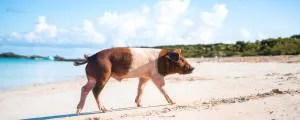
Draft decides less than people expect elsewhere. Thunderball Grotto, Shroud Cay and Pig Beach are tender trips for every boat.
Broker insight
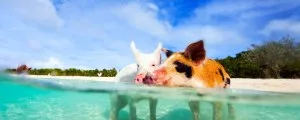
That first trip from Nassau to the Exumas is about a five-hour sail on a catamaran. On a motor yacht, depending on the size and power, it is more like two to three hours. You board in the morning, and you are swimming with the pigs that same afternoon.
 Chris de Kock
Charter Broker, Sales Broker, Active CYBA Member
Chris de Kock
Charter Broker, Sales Broker, Active CYBA Member
3. Getting there: fly into Staniel, not Nassau
A 7-night Exumas charter starting in Nassau spends its first and last day crossing the banks to reach the good part of the chain. That is two of your seven days.
Flying into Staniel Cay instead puts you in the middle of it and buys back a cruising day at each end. Makers Air flies Fort Lauderdale to Staniel daily. Flamingo Air covers Nassau to Staniel in about 40 minutes.
An Abacos week is different again and starts at Marsh Harbour.
More: our guide to getting to your yacht compares all three doors in, including why we talk clients out of the Florida crossing.
4. Finding real seclusion
Seclusion in the Bahamas is a routing decision, not a destination. You can have an anchorage entirely to yourself, but not on a standard Exumas week.
The famous stops are the busy ones. Pig Beach and Thunderball Grotto are on every itinerary in the chain, and in season you will not have either to yourselves.
The genuinely empty islands sit off the usual loop: Andros, Cat Island, Long Island, Inagua and the Berries. The southern ones need 10 nights or more, plus a yacht with the range for remote anchorages.
So decide early. If seclusion is the point of the trip it changes the itinerary length and the boat, and it is not something to raise in week two of planning.
More: our five most secluded islands, with the anchorages we use on each.
5. What it costs: budget about half again
The advertised rate is not the bill, and the gap is bigger than most people expect. A Bahamas quote has four parts and only one of them is the headline.
The charter tax is a flat 14 percent, charged on the base fee only, not on the onboard budget or the tip. It falls due with the final payment, roughly six weeks before you board.
The onboard budget, the APA, runs 25 to 40 percent of the base fee. It behaves like a wallet rather than a fee: the crew spend from it and whatever is left comes back to you with itemised accounts.
Crew gratuity is customary at 15 to 20 percent of the base fee.
So a $100,000 week commits closer to $150,000, of which the unspent onboard budget returns. Nearly every Bahamas motor yacht works this way. A handful of catamarans run all-inclusive, which is the norm in the Virgin Islands rather than here.
When two quotes disagree the difference is almost always structure, not price. A quote led by the bare charter fee looks cheaper until the tax and the onboard budget arrive.
More: our cost guide and our guide to tax and fees.
6. How many crew: three
Crew number tracks guest number closely here. At 6 guests it is almost always 2 crew. At 8 the choice is real. From 10 up, nearly everything carries 4 or more.
Three is the number that changes the week, because that is where one person’s whole job becomes food. At 4 the chef does nothing else. Below 3, cooking shares a person with the tender, the laundry and the cabins.
One Bahamas-specific point: on many crewed catamarans the second crew member is the chef, listed as chef and first mate. A 2-crew boat is not automatically a boat with no cook. Read the crew list, not the crew count.
Price tells you less than you would think. Three Bahamas boats, all taking 8 guests: SEAGLASS 74 carries 3 crew from $72,000 plus expenses. SWEET VIRGINIA carries 5 from $85,000 plus expenses. ENDLESS HORIZON carries 4 from $93,000 all-inclusive.
The cheapest has the fewest crew, but the dearest has fewer than the middle one, and it is the only one with food already in the rate. Never compare an all-inclusive rate against a plus-expenses one as though they were the same number.
More: our crewed catamarans in the Bahamas.
7. Big groups: the fleet stops at 12
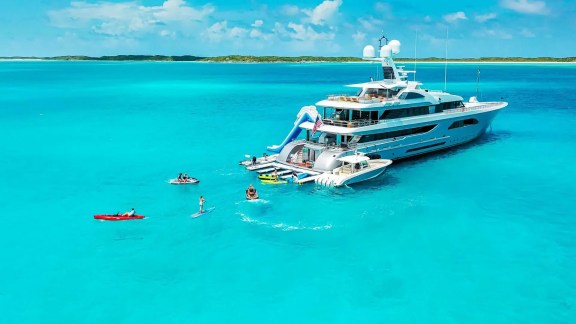
Twelve guests is not a soft limit here, it is the end of the fleet. A live sweep in September 2026 returned exactly one Bahamas-listed yacht sleeping 13 or more, and her seasons are Greece and Turkey.
At 11 or 12 the answer is cheerful. Around 30 motor yachts with a Bahamas season take 12 guests, most between roughly $100,000 and $320,000 a week plus expenses. Catamarans run out earlier: above 10 guests there is essentially one.
Ask for the cabin table with bed sizes before anything else. Three Bahamas yachts all sleep 12 in 6 cabins and suit three completely different groups.
STARSHIP 185′ has four king staterooms plus two cabins each holding two queens, so six couples fit but two pairs share. LADY JOY has four kings plus two cabins with a double, a single and a Pullman, which is four couples and a stack of children. EMINA has four doubles plus two listed as twins with no bed sizes published.
That is the lesson. The word twin on a spec sheet tells you nothing until you see the drawing, so we send the cabin table rather than the cabin count.
If your group is 14 or more there is no bigger boat. Most take two yachts cruising together, which means two contracts, two crews to tip, and one captain agreed as lead on routing.
What to tell us before we shortlist
Our first question is never what kind of yacht you want. It is why you are going, because a reunion where nobody has seen each other in five years is a different boat from a dive week.
Five things move a Bahamas shortlist more than anything else: why you are going, the exact ages of everyone aboard, and whether you want to eat aboard every night.
Then two nobody volunteers: who in the group is difficult about something and what it is, and whether you want the crew around or want to forget they exist.
Send us those and your dates, and we will come back with a shortlist that already accounts for the crew count, the cabin table and the shop at the hub.
People also ask
Can you bring your own alcohol on a Bahamas yacht charter?
Yes, and most crews welcome it. On a plus-expenses charter the drinks come out of your own onboard budget anyway, so bringing your own simply saves you money.
The limit is not the yacht, it is customs. Each arriving adult may bring in one quart of spirits and one quart of wine duty free, plus $100 of other goods. Above that, duty applies.
Do you get the APA back?
Yes. Whatever the crew does not spend is returned at the end of the charter, with itemised accounts. The APA runs 25 to 40 percent of the base fee and covers fuel, food, drink, dockage and the yacht’s running costs for the week.
A lower APA is not a saving. It is a smaller onboard budget that you top up later if the week runs through it.
How many crew do you need on a Bahamas charter?
Two crew is the working minimum, three is where one person’s whole job becomes food, and four is where the chef stops doing anything else.
In the Bahamas the fleet mostly decides this for you. At 6 guests it is almost always 2 crew. At 8 there is a genuine choice, with most boats at 4 or more, about a third at 2, and a few at 3. From 10 guests up nearly every Bahamas yacht carries 4 crew or more, and the only exception we can find is one 12-guest catamaran.
What is the maximum group size for a Bahamas yacht charter?
Twelve guests. A live sweep of the Bahamas market in September 2026 found exactly one yacht sleeping 13 or more, and her seasons are Greece and Turkey, so in practice the answer is nothing.
Groups of 14 or 16 take two yachts cruising together, or put 12 aboard and the rest ashore for part of the week. Toddlers count toward the 12, which surprises most families.
Are Bahamas charters all-inclusive?
Almost never. Nearly every Bahamas motor yacht charters on plus-expenses terms, with a flat 14 percent charter tax on the base fee and an APA on top. A handful of catamarans here run all-inclusive rates.
If all-inclusive is what you want, the Virgin Islands are where it is the norm rather than the exception.




 iMessage
 WhatsApp